Research
Overview: Decomposing Judgment in Cultural and Organizational Life
When actors evaluate cultural artifacts, behaviors, and forms of communication, the judgment presents itself as a single overall impression: a verdict on the act or object as a whole. My work shows that these judgments do not in fact respond to acts and objects as wholes. They respond to particular constituents of those acts and objects, read in context, and the constituent that drives the outcome is rarely the one the overall impression would credit.
These judgments matter because they do not remain impressions. In cultural and organizational life, they become allocation mechanisms: they decide which products are rewarded, which behaviors are condemned, which people get hired, which speakers are credited with authority, and which successes are taken as models for imitation. Because these allocations cumulate, judgments that appear aesthetic, moral, or stylistic in the moment shape durable differences in visibility, legitimacy, resources, authority, and opportunity across people, groups, and organizations.
What distinguishes my approach is not that judgments are affected by separable features; much social science already proceeds from that premise. It is that, in the domains I study, the relevant constituents are not available as conventional variables. They have to be analytically derived from objects that appear, to participants and often to scholars, as indivisible wholes. I develop decompositions of these objects that are both theoretically meaningful and empirically measurable. This lets me measure directly, and typically at scale, constructs that prior work could only proxy or assert. With object and judgment side by side, I can identify which constituents drive the judgment and how far the judgment departs from the object’s measured composition. The result is an account of how judgments misdescribe their objects: attaching to particular constituents while appearing to answer to the whole.
Substantively, my work is anchored in culture and the creative industries, where holistic judgment has long been the primary evaluative frame and where the return to decomposing it is greatest. Its implications extend to organizations and markets, especially cultural product markets, because these settings depend on judgments of style, authority, legitimacy, reputation, and success. Across these settings, I combine computational analysis of digital trace data with field, experimental, and archival data, and use machine learning and AI for measurement and analysis at scale.
Publications
Stylistic Differentiation in Cultural Markets: The Benefits of Conspicuous Category Spanning. Organization Science, 2026.
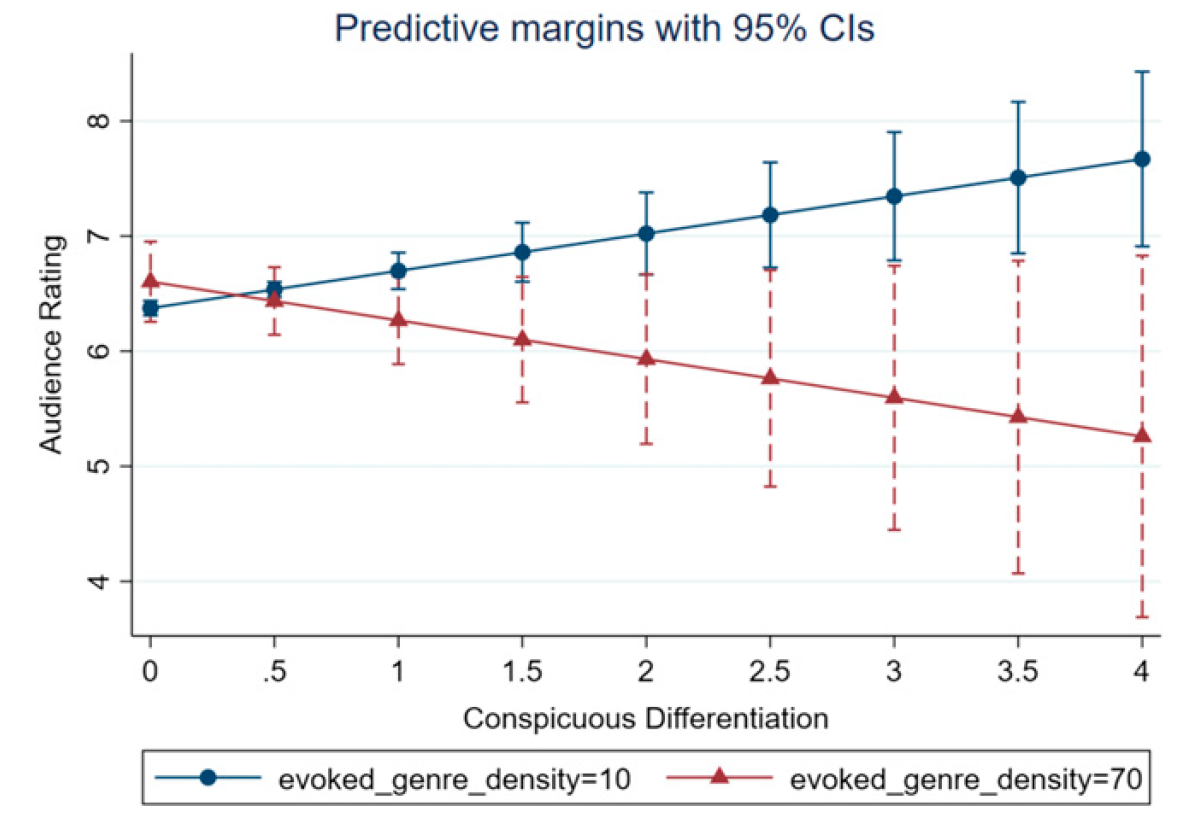
Creative industries run on recombination. Films, songs, and shows routinely borrow from genres other than their own, and the standard advice is to be novel but not too novel. That advice is hard to act on, because the same body of work warns that crossing categories carries a penalty. So when does borrowing across genres help, and when does it backfire?
Drawing on the narrative features of nearly 6,000 films, the paper finds that borrowing works when it is conspicuous, meaning the borrowed elements are familiar and easy for audiences to recognize. It also finds that borrowing from thinly populated genres pays off more than borrowing from crowded ones, because audiences grow tired of elements tied to oversaturated genres. These results bring together two lines of theory that had developed separately, one on effective differentiation and one on the penalties to category spanning.
What decides a film’s fate here is a measurable property of the film itself: how recognizable its borrowed elements are within their category and across the field, not its overall quality and not the bare fact that it spans genres. Because the films are broken into their constituent features before any outcome is examined, that property can be separated from the impression of a film being simply good and shown to carry the effect on its own. The feature that matters is built into the object rather than projected onto it, which is why an account that treats the film as a whole tends to miss it.
Cultural Tariffing: Appropriation and the Right to Cross Cultural Boundaries (with Amir Goldberg and Yael Berda). American Sociological Review, 2024.
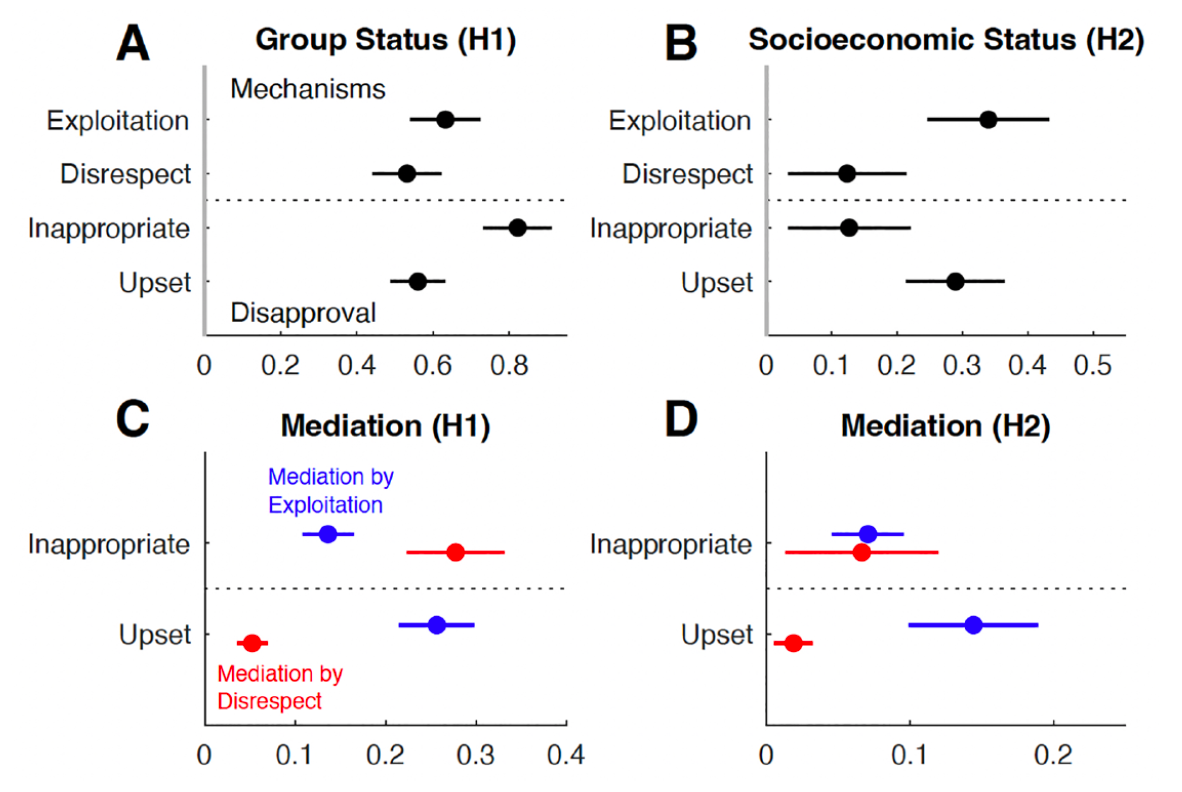
In the late 2010s and early 2020s, cultural appropriation moved to the center of public debate and institutional decision-making. Why did it surface so suddenly, and why did it carry such force? Most attempts to explain it have been interpretive or narrow in scope. This paper sets out to explain it empirically, drawing on a large and representative sample.
Some acts of cultural borrowing pass without comment while others are condemned as appropriation. The paper argues that the difference reflects a shift in how members of high-status groups now consume culture. As drawing on many cultures became a marker of status in itself, crossing cultural boundaries turned into a way of accruing value, and observers came to judge each crossing by who stands to gain from it. People object when they see a borrower extracting value at the expense of the culture being borrowed from, according to aspects of the actor’s identity that they believe already convey social value. The paper calls this cultural tariffing, a social cost levied on boundary-crossing, and finds that observers’ reactions turn on their beliefs about inequality.
Read this way, appropriation is not a reflex but a structured judgment. What moves the verdict is a single separable feature of the situation, the value an observer reads as changing hands given the standing of the parties, rather than the borrowing itself. Because the study varies those features independently, it can isolate the one that decides the reaction and show the same act drawing approval or condemnation as that feature changes.
Working Papers
Working paper, under review. Draft.
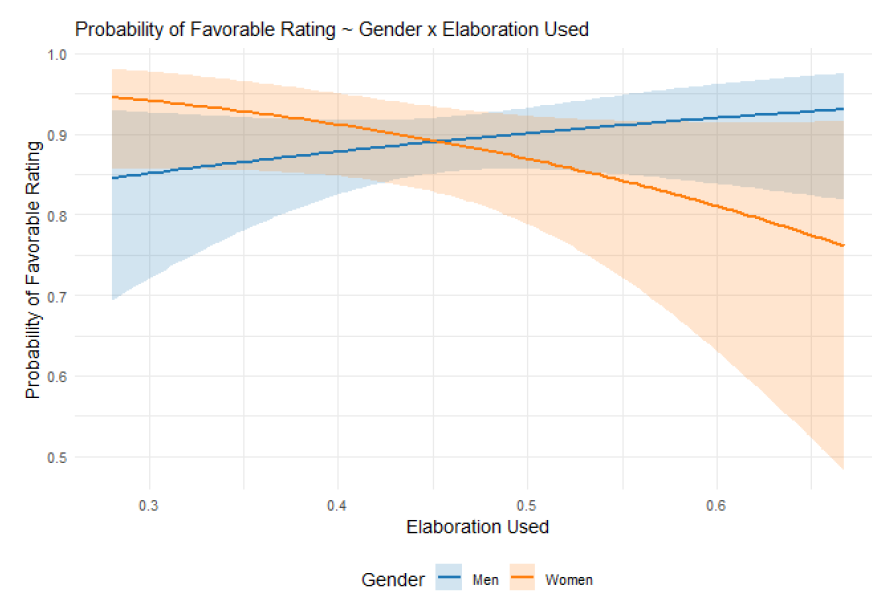
It is well known that women are penalized for workplace communication that sounds authoritative, and the usual explanation is that they are being sanctioned for acting against type, for being insufficiently feminine. This paper finds a different mechanism underneath, and it points the other way. What if the penalty has nothing to do with policing femininity at all?
The study looks at a detailed, explanatory way of speaking that is generally coded as feminine but that, inside organizations built on specialized expertise, becomes a marker of authority through its role in helping others across the ranks solve problems. Analyzing workplace text with natural language processing, the paper finds that women, especially those not in management, are penalized for using this style, while men are not. Because the style is coded feminine, the standard account cannot hold. Women are punished here for communicating in a gender-typical way, and the men for whom the same style is gender-atypical pay no penalty at all. The penalty is not about gender nonconformity. It is about who is permitted to claim standing their position has not granted them, and gender decides who is held to that line and who is exempt. Supporting this, the penalty concentrates in speaking upward to managers, it tracks a person’s standing rather than fixed traits, and it disappears for women once they are promoted into management.
The behavior being judged is held constant. What changes its value is the standing of the person using it and whether that person is perceived as reaching above their station, not the style itself, which is why the same feature is rewarded for some speakers and punished for others. Measuring the style independently of the reactions it draws is what exposes the real mechanism, since the surface verdict, that the woman was being too aggressive or unfeminine, misattributes cause. The driver is a structured reading of status entitlement that no judgment of the style on its own would reveal.
Work in Progress
Profit or Prestige? Selective Conformity under Multi-Audience Evaluation (with Lingyun Zhang and Anthony Palomba).
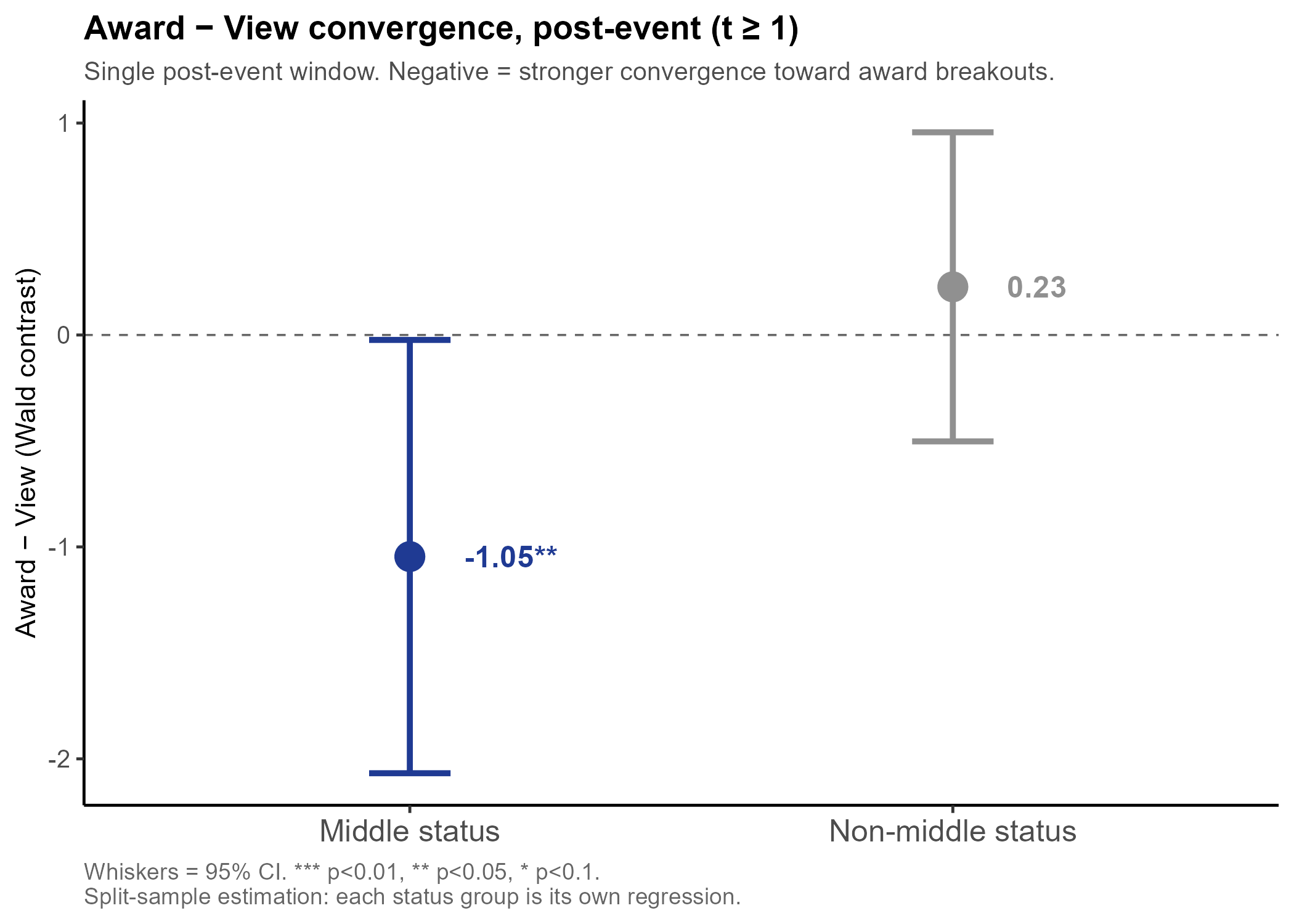
Organizations learn by copying what works, a premise at the center of how we explain the spread of practices. But imitators can all see the same hits, and they copy some while ignoring others of comparable size. What determines which successes get imitated?
The paper argues that what matters is the legibility of a success, meaning whether a public and credible account exists of why it happened and what to copy. When the reasons behind a success are spelled out, would-be imitators know where to direct their attention and imitation follows. When the reasons stay vague, even a large and visible success goes uncopied. The study tests this in U.S. television, where shows are judged at once by award juries and by mass audiences. An award win arrives with a ready explanation, since the category names what was honored and critics set out why it worked, while high viewership comes with less concentrated and consistent accounts of its causes. Despite being less directly tied to revenue, award-driven breakouts draw imitation, concentrated among middle-status producers, while viewership breakouts of comparable size do not.
The lever here is not the size of a success, nor the strength of its connection to profitability, but whether it comes with a usable account of its own causes, a feature that lives in the discourse around the show rather than in the show. Holding the success apart from the talk that surrounds it, and measuring each on its own, makes visible that what gets copied is an explanation, not an achievement. The constituent that drives imitation is again not the one a tally of viewers or awards would point to.
Identity-Signal Misalignment, Expectation, and Creative Valuation (with Tosen Nwadei).
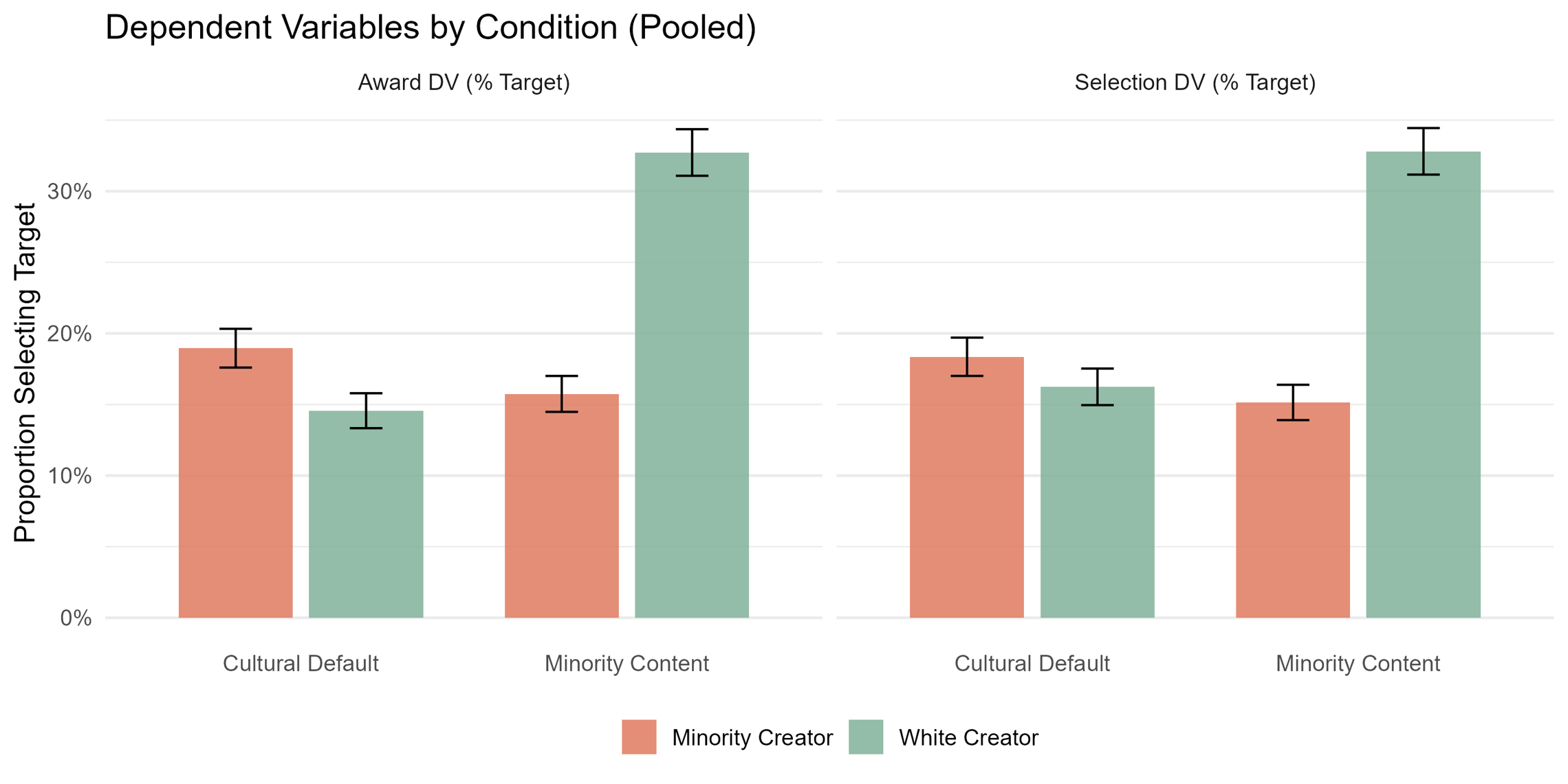
Creativity is usually evaluated as if it inheres in the work: the song, the design, the show, the portfolio, the idea. Research has examined the conditions that make creative work possible and the features that make creative products successful, but it often leaves the act of evaluation itself intact. Once the work is in front of an audience, the judgment is assumed to track the work. What if evaluations of creative capacity are shaped not only by what the creator made, but by whether the work seems expected from someone like them?
The paper argues that racial identity functions as a signal of what a creator is likely to produce. When the cultural coding of a creator’s work fits that expectation, the pairing reads as ordinary. When it violates the expectation, evaluators infer broader interests, wider experience, or a more expansive imagination. Because breadth is a central cue for creativity, the same work can become stronger evidence of creative capacity for one creator than for another.
Across four preregistered experiments in television writing, graphic design, and live music, participants evaluate fictional emerging creators whose race and prior work are varied independently, while credentials and quality cues are held constant. They choose which creator is most likely to win an award for bold, outside-the-box work and which creator they would hire or work with. White creators receive disproportionate gains when they produce minority-coded work, on both recognition and selection outcomes, while Black and Asian creators receive much more negligible benefit for producing similarly juxtaposed work.
Read this way, creative valuation is not simply a judgment of the work or of the creator. It is a judgment of the relation between the two. What appears to reward imagination is also rewarding how surprising the work seems given the creator’s social identity. The constituent that drives the judgment is not the quality, originality, or content of the work alone, but the structured expectation against which the work is read. In creative labor markets, that misdescription matters because judgments of creative capacity become allocations of recognition, hiring, and opportunity.